
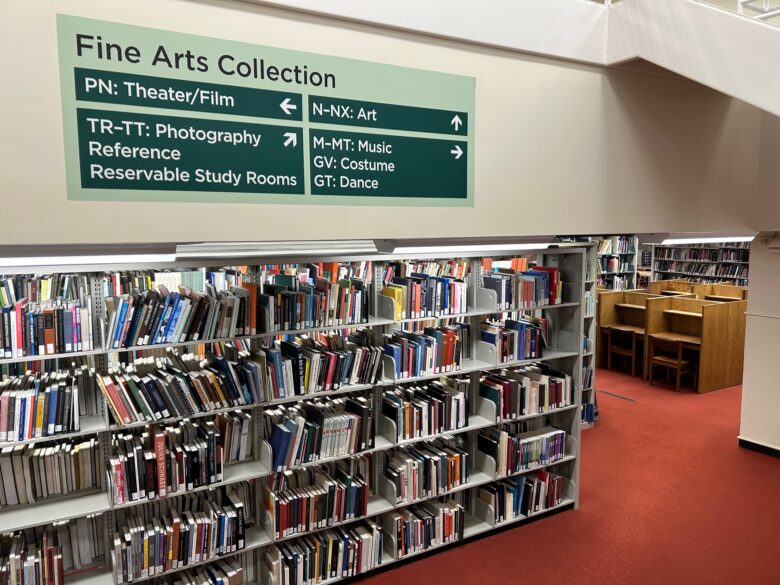
The Fine Arts Collection at Binghamton University Libraries contains a variety of interesting and themed collections in the arts, such as the Miniature Scores collection, the Microform collection, the Contemporary Playscripts collection, and more. All of the collections highlighted in this blog from the Fine Arts Collection are primarily print collections, consisting of print materials with a few electronic doubles in the digital library. I focused on three collections in this blog: the Handicrafts collection, the SPOTLIGHT collection (featured materials), and the Miniature Scores collection.
To fully capture the essence of the collections, I consulted Emily Creo, the visual and performing arts librarian. Her role in the Libraries is to manage and further build on the existing arts collections and to provide support for the research and creative practice of students and faculty through library resources.While there is ease of accessibility for digital collections, she emphasized the importance of the physical materials in the Fine Arts Collection for both the visual and performing arts.
“We musicians like print music because we can easily annotate on the page and mark practice or rehearsal notes with a pencil,” said Creo. “It’s becoming more commonplace in recent years to use a tablet and annotate a digital copy, but with digital scores we can face issues with copyright or disseminating music that way.” In terms of visual arts materials, Creo said, “Many art book publishers still publish exclusively in print, so that availability of materials impacts what format we collect, but there is also the benefit of having high quality reproductions of art not at the mercy of screen resolution.”
The primary objective of the Fine Arts Collection, said Creo, was to pull together the various arts-related materials across the University’s collections and to put them in proximity to each other for ease of browsing and use for arts students. “The Fine Arts Collection makes a statement that the arts are a serious discipline in university studies, and these resources support unique forms of scholarship in serving creative work, and we pull these materials together to assist that.” said Creo. The ease of browsing the physical materials in the Fine Arts collection allows students to find materials beyond what they need or what is required for their studies, which might change the trajectory of their interests and their studies and fuel their curiosity regarding the arts.
Handicraft Collection
The handicraft section in the Fine Arts Collection covers materials on crochet, knitting, jewelry making, leather working, weaving, embroidery, natural dying, kumihimo (a form of traditional Japanese braiding), visible mending, sashiko (a form of traditional Japanese embroidery), and more. Creo has been working on growing the collection since she started working at the Libraries three years ago, and she remarks how the usage has skyrocketed in the last few years, as is evident in the holes within the shelves from the absence of materials that have been checked out.
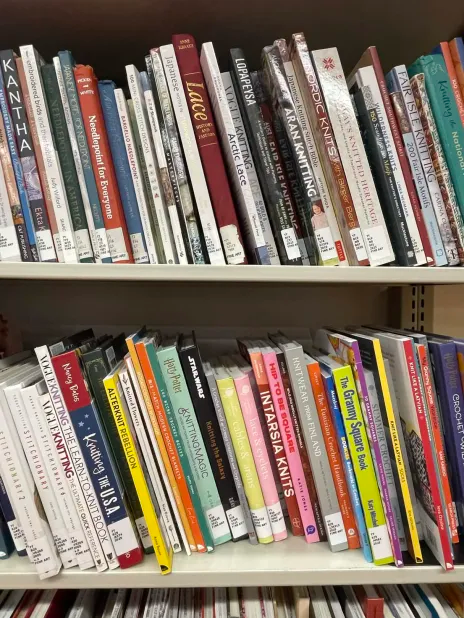
Because this section of the collection covers all types of traditional crafts and handicraft materials, the range of topics within the materials housed in the handicraft collection varies as well: there are tutorials on different types of handicrafts, books on the history of handicrafts in different parts of the world. While the collection is worthwhile from a hobby standpoint, Creo mentions how much use and function it has from a research standpoint and a studio arts standpoint. “Handicraft can often inform an artist’s practice in various ways, either through incorporating or being inspired by craft forms.”
“There is research about how engaging in handicraft can mimic the research process, and learning new skills and having a creative outlet is good for our brains as well,” said Creo. “In terms of scholarship, these materials can help students learn and focus on process, but they also generally enhance the creative experience for our campus community, the Handicraft collection – and Fine Arts, in general – embodies both goals.”
SPOTLIGHT Collection: featured selections
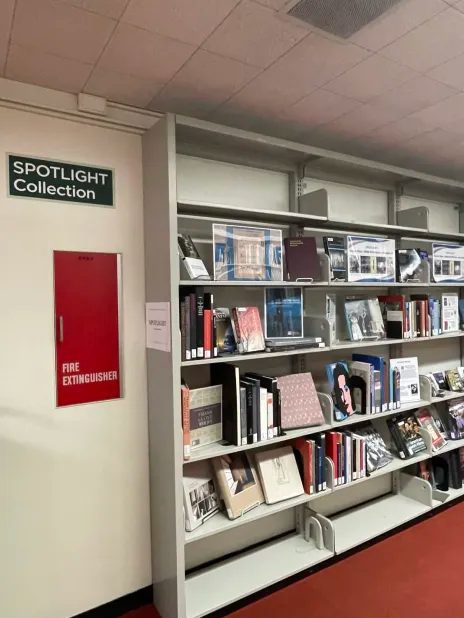
One of the other collections Creo has started this semester is the SPOTLIGHT collection, which includes featured selections from the overall Fine Arts Collection. The primary objective of the featured selections is to present featured materials that align with events, exhibitions, or classes happening at the University. The secondary objective is to pull together the different forms of art in that genre and to put them in proximity to each other so students can learn through a variety of mediums such as books, songbooks, and CDs.
Currently, the collection highlights two different spotlights: The Spring 2026 Exhibitions at the Binghamton University Art Museum, as well as Klezmer Music, Yiddish Performance, and Jewish Art. The spotlight that aligns with the Binghamton University Art Museum’s exhibit this semester features works on the architecture and drawings of Frank Lloyd Wright, Japanese woodblock prints and Japanese art in America, as well as the Arts and Crafts movement in America. The second spotlight on Klezmer Music, Yiddish Performance, and Jewish Art was created in support of a Yiddish culture class in the Judaic Studies department, which is focusing on Yiddish language and arts. The spotlight takes an expansive view, including books on Jewish artists and museums, books on Yiddish cinema and theatre, along with multiple formats exploring Klezmer music including books, songbooks, sheet music, and sound recordings. In terms of the future of the SPOTLIGHT collection, Creo hopes to change the theme by semester and to receive faculty recommendations on what should be highlighted. The section has been quite popular, with materials checked out and browsed over in passing. Because of how the collection is structured, it allows students to experience their interest in different types of ways and to fuel their curiosity in a subject through different mediums.
Miniature Scores Collection
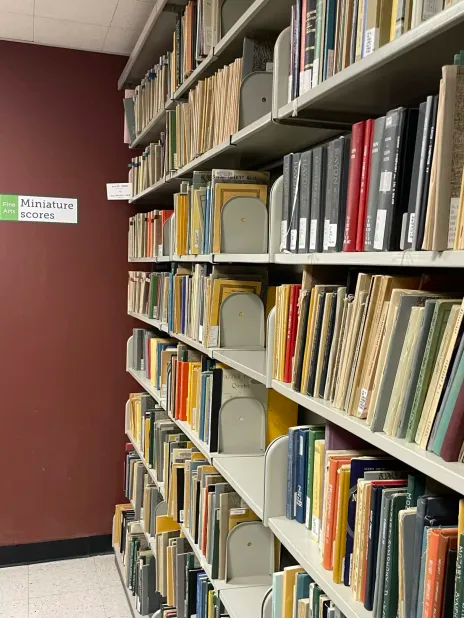
On top of the regular music scores collection (which covers a vast area of the Fine Arts Collection), there is another music scores collection that is housed by size: the Miniature Scores collection. The Miniature Scores collection are musical scores which are smaller and more specific editions of various scores and kept in a separate area in Fine Arts because they could get lost within the regular stacks.
Miniature scores were popularized in the late 19th and 20th century. Due to their size, they would be cheaper to produce and buy. In the Libraries, these miniature scores act as a helpful addition and a backup to the regular-sized scores. “There’s a general rule that the library doesn’t collect multiples of the same title. However, having multiple editions and formats of scores is necessary for several reasons, and if there is a production happening with many people involved needing access to the same score, it can be advantageous to have these study scores as a backup.”
While the miniature scores attract a lot of attention from students, Creo mentions that these are not actively collected and added to the collection as much due to the more regular utilization of regular-sized scores. “The portability and pricepoint were the outstanding qualities for this format of score, but for academic study or for performance use, those aren’t primary concerns, so we collect various regular size editions to better meet needs.”
There is a lot more to explore in the Libraries if you take a moment to see what’s on the shelf! Learn more about the fine arts collection by visiting it in person or browsing lib guides on the Libraries’ website: https://libraryguides.binghamton.edu/srch.php?q=fine+arts